Closed vs Open Models. The AI Model Divide.
As the AI stack matures, a central debate has emerged: Will frontier model labs own the operating intelligence of the enterprise, or will businesses reclaim their data sovereignty through open and specialized models?
"Proprietary versus open is not a thing. It's proprietary *and* open." — Jensen Huang, CEO, Nvidia, GTC 2026
The enterprise AI landscape is rapidly evolving from experimental chatbots to core operational infrastructure. As this shift accelerates, a fundamental tension has surfaced regarding who will ultimately control the operating intelligence of the enterprise. On one side are the frontier model vendors — such as Anthropic, OpenAI, and Google — pushing a vision where massive scale and generalized intelligence dominate the stack. On the other side is a growing movement toward "dispersed intelligence," advocating for data sovereignty, open models, and proprietary systems of intelligence that protect an enterprise's unique business advantage.
The Performance Gap Is Narrowing
For years, the debate was settled by a simple benchmark reality: proprietary frontier models were simply better. That assumption is now being challenged by the data. According to the Artificial Analysis Intelligence Index v4.1 — which aggregates nine rigorous evaluations including Humanity's Last Exam, GPQA Diamond, and SciCode — open weights models have risen from near zero in late 2022 to a score of 48 by mid-2026, compared to a proprietary frontier score of 60. The gap, once insurmountable, is now a matter of a single model generation.
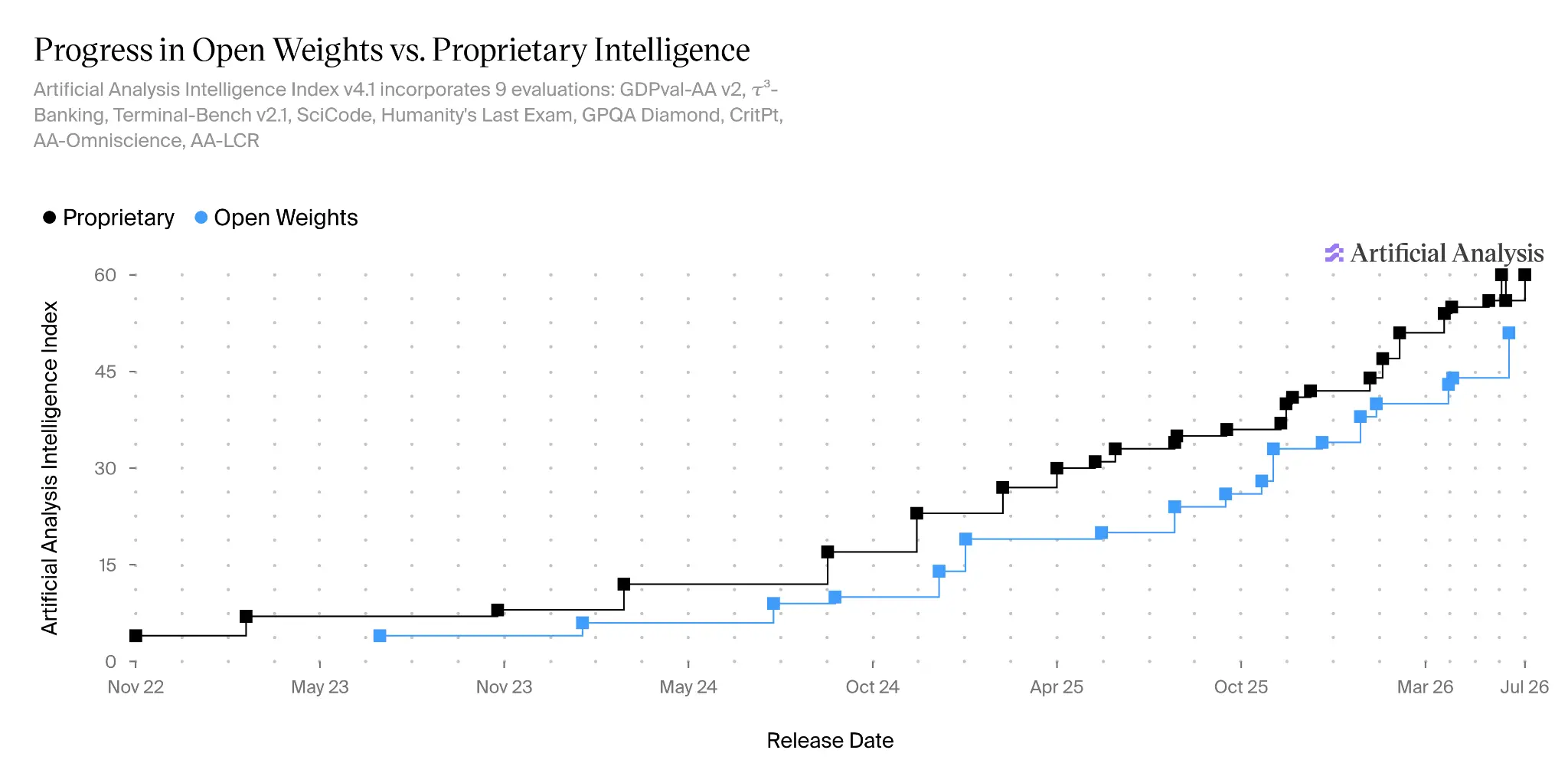
Progress in Open Weights vs. Proprietary Intelligence, measured by the Artificial Analysis Intelligence Index v4.1. Source: [Artificial Analysis](https://artificialanalysis.ai/trends), July 2026.
When viewed at the model level, the picture is even more striking. Open weights models such as GLM-5.2 (51), Qwen3.7 Max (46), MiniMax-M3 (44), DeepSeek V4 Pro (44), and Meta's Muse Spark (43) now sit directly alongside proprietary models in the same intelligence band — with only the very top tier of closed models (Claude Fable 5 at 60, GPT-5.5 at 56, Claude Opus at 55) maintaining a meaningful lead.
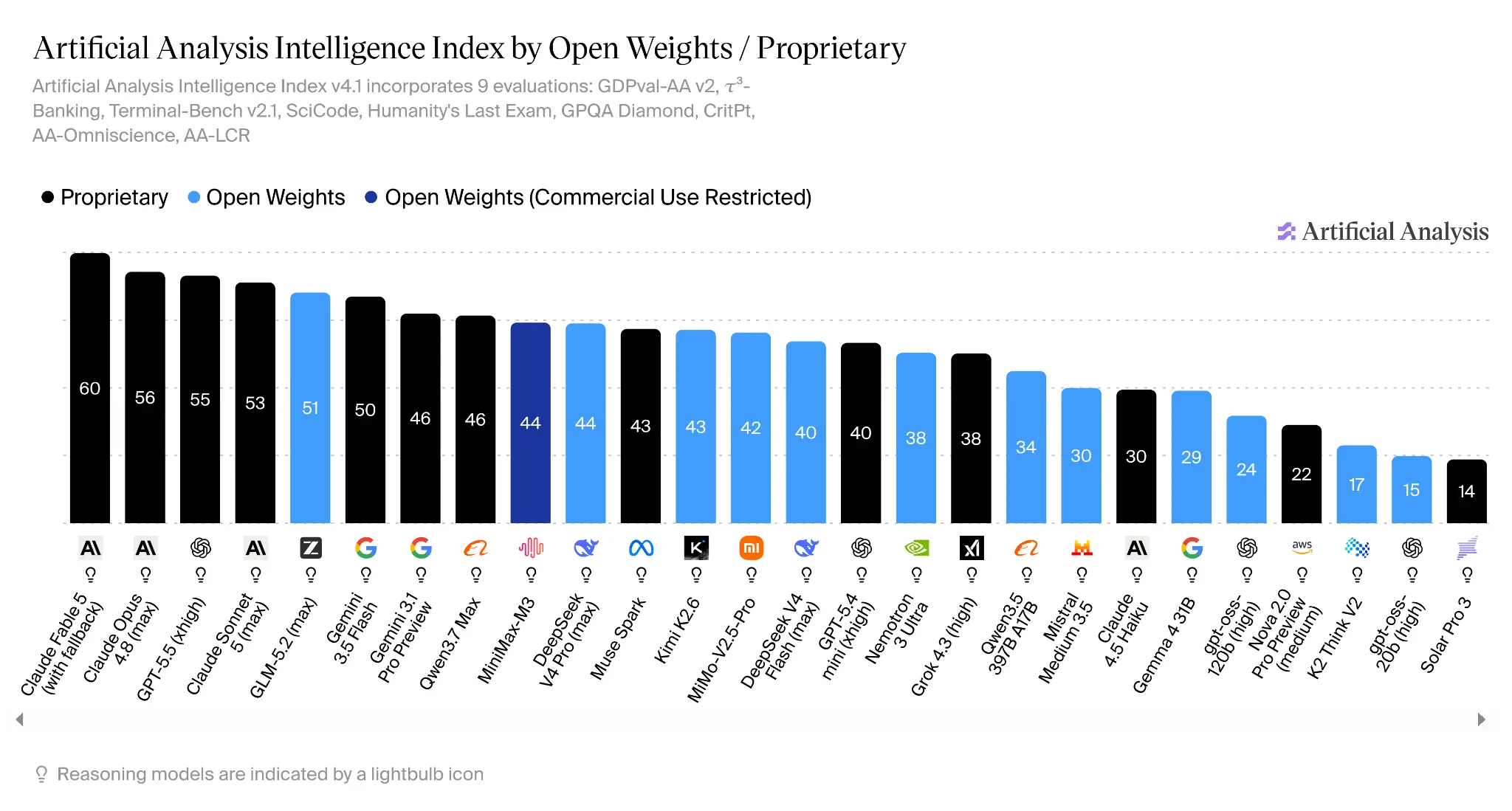
Artificial Analysis Intelligence Index by Open Weights / Proprietary, showing current scores across 27 leading models. Source: [Artificial Analysis](https://artificialanalysis.ai/trends), July 2026.
The Frontier Model Dominance Case
The argument for frontier model dominance is rooted in scale, economics, and utility. Frontier models operate as a "cognitive surface," leveraging massive compute power, vast data lakes, and continuous high-frequency learning loops from consumer usage. Proponents argue that the utility, cost curves, and research velocity of these models will outpace all alternatives.
If frontier models continue to improve rapidly while inference costs fall, enterprises may find that the marginal cost of tokens is significantly lower than the marginal cost of human labor. In this scenario, frontier vendors could become the lowest-cost providers of high-utility intelligence, effectively owning the cognitive layer and potentially expanding into the enterprise system of intelligence itself. Anthropic's recent surge, commanding roughly 40% of enterprise AI spending, underscores the momentum behind specialized, high-performance proprietary models in the corporate sphere.
Key Statistics
Enterprise AI Spend: Surged from $1.7B in 2023 to $37B in 2025, growing faster than any software category in history (Menlo Ventures, 2025). Frontier Market Share: Anthropic commands ~40% of enterprise AI spending, while OpenAI's share has halved from 50% to 27% since 2023 (LinkedIn / Mike Bayly, 2026). Open Source Adoption: Open-source LLMs hold only 11% of the overall market, but developer preference is driving hybrid deployments (Menlo Ventures, 2025). Sovereignty Prioritization: The percentage of enterprise executives listing AI sovereignty as a priority surged from 41% to 93% by early 2026 (Meta Intelligence, 2025).
The Sovereignty and Dispersed Intelligence Counterargument
The counterargument, championed by leaders like Palantir's Alex Karp, centers on trust, control, and the preservation of proprietary "alpha." The concern is that relying exclusively on closed frontier models amounts to "data communism," where unique enterprise knowledge is absorbed and homogenized by the model providers.
Enterprises do not run on intelligence alone; they run on specific rules, policies, regulatory constraints, and tacit human judgment. A frontier model may reason brilliantly but lack the specific operational context of a business. This necessitates a "System of Intelligence" (SoI) — a layer that manages inputs, enforces policy, and captures business logic as a governed asset. Advocates for dispersed intelligence argue that the SoI is the true strategic control point, and it should remain independent of the underlying model. This approach favors a multi-model future, utilizing open-source models like Gemma, DeepSeek, GLM or Kimi, which provide the ability to deploy locally or within sovereign environments, ensuring data never leaves the organizational boundary.
The Hybrid Reality: Proprietary and Open
The ideological debate between open and closed models often obscures the operational reality: enterprises need both. As Nvidia CEO Jensen Huang noted, the future is "proprietary *and* open."
Organizations are increasingly adopting a hybrid approach. They may use powerful frontier models for complex reasoning tasks while deploying open-source models for cost-sensitive, latency-critical, or highly regulated workflows. Model routers and AI gateways are emerging as essential tools, allowing enterprises to dynamically direct workloads to the most appropriate model based on cost, performance, and governance requirements. This optionality prevents architectural dependency and ensures that the enterprise operating model is not trapped within a single vendor's ecosystem.
In Summary
As AI becomes deeply integrated into enterprise operations, the choice of model architecture is a critical strategic decision. The future will likely be defined by organizations that successfully blend the raw power of frontier models with the control and specificity of proprietary systems of intelligence.
Sources
[1] D. Vellante, "Alex Karp, frontier models and the real fight for Enterprise AI," SiliconAngle, July 5, 2026.
[2] T. Tully et al., "2025: The State of Generative AI in the Enterprise," Menlo Ventures, December 9, 2025.
[3] M. Bayly, "The Frontier AI Race: Where Things Stand, March 2026," LinkedIn, March 30, 2026.
[4] Digital Applied Team, "Open Source AI Models for Enterprise: Complete Guide 2026," Digital Applied, January 22, 2026.
[5] Artificial Analysis, "Progress in Open Weights vs. Proprietary Intelligence," Artificial Analysis AI Trends, July 6, 2026. https://artificialanalysis.ai/trends
Written by Henon
The opinions expressed are those of Henon Financial Technologies Inc. ("Henon"). The information and/or analysis contained in this material have been compiled or arrived at from sources believed to be reliable but Henon does not make any representation as to their accuracy, correctness, usefulness or completeness and does not accept liability for any loss arising from the use hereof or the information and/or analysis contained herein. Henon disclaims any responsibility to update such information. Neither Henon or its affiliates, nor any of their directors, officers or employees shall assume any liability or responsibility for any direct or indirect loss or damage or any other consequence of any person acting or not acting in reliance on the information contained herein. All overviews and commentary are intended to be general in nature and for current interest. While helpful, these overviews are no substitute for professional tax, investment or legal advice. Clients should seek professional advice for their unique situation. Neither Henon nor any of its affiliates or representatives is providing tax, investment, or legal advice. Past performance does not guarantee future results. This material was prepared solely for informational purposes, does not constitute an offer or an invitation by or on behalf of Henon to any person to buy or sell any security and is no indication of trading intent in any fund or account managed by Henon. No investment strategy or risk management technique can guarantee returns or eliminate risk in any market environment. Unless otherwise specified, all data is sourced from Henon. The Stylized Henon Design, and Henon Logo are trademarks of Henon Financial Technologies Inc.