AI Feels Like It Saves 36 Minutes. The Reality Is Closer to 12.
AI feels dramatically faster than it actually is. Here's what measured studies found.
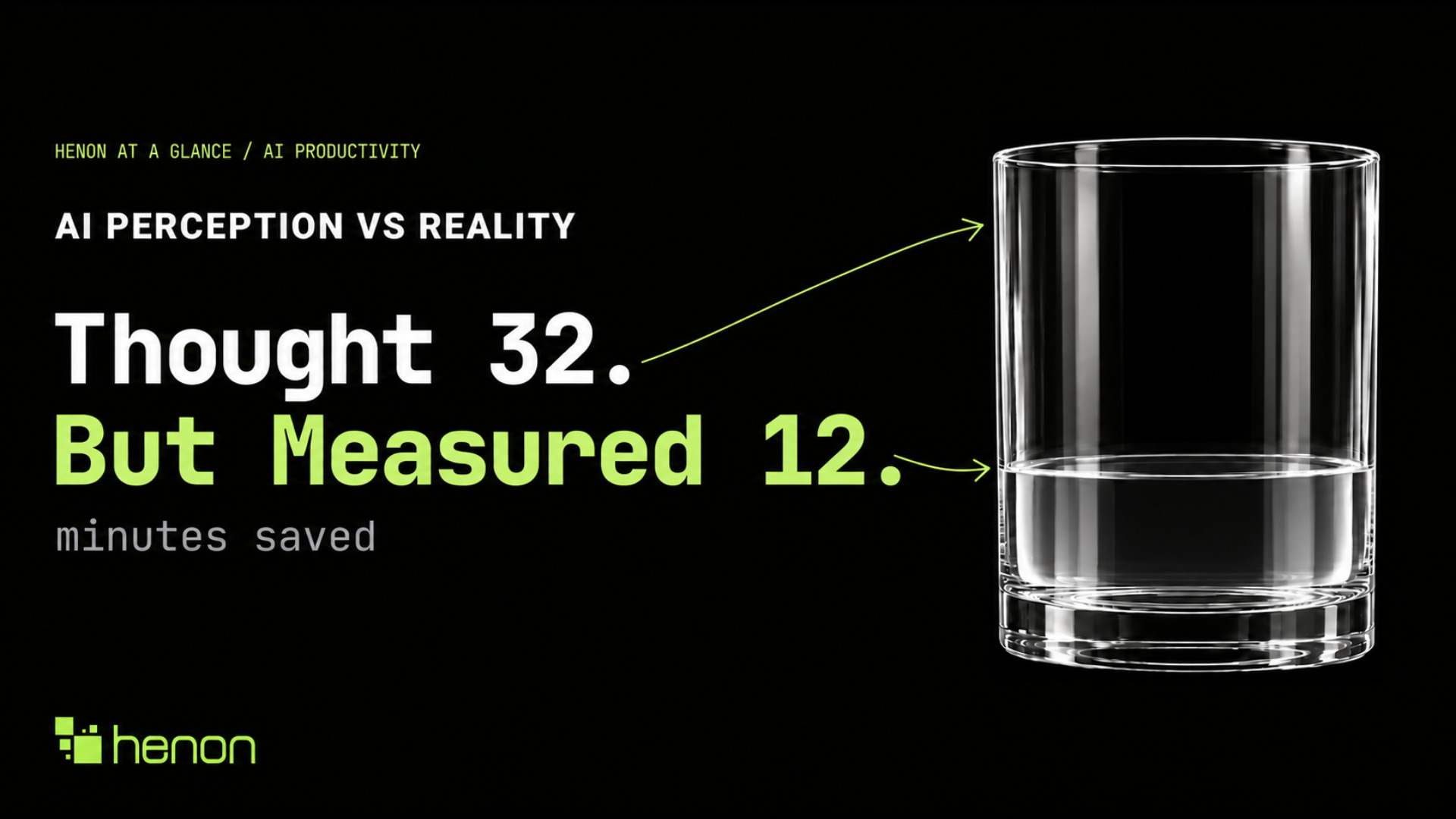
Task by task prompting vs real productivity or.. Perception vs Reality
As generative AI copilots become embedded across the workplace, a fundamental question has emerged: do these systems actually save meaningful time, or does the perceived benefit exceed the measured reality?
The answer matters because productivity has become the primary justification for enterprise AI investment. Organizations are deploying copilots across writing, research, spreadsheets, presentations, and communication workflows, yet leaders increasingly want evidence of measurable outcomes rather than anecdotal success stories.
Recent research suggests that both advocates and skeptics may be overstating their case. While GenAI copilots can create meaningful efficiency gains in specific workflows, the measured results are often substantially smaller than users believe.
The Productivity Gap Is Smaller Than Expected
For many users, GenAI feels dramatically faster than traditional work. Drafts appear in seconds. Summaries can be generated almost instantly. Presentations and spreadsheets can be produced with a handful of prompts.
Measured outcomes tell a more nuanced story.
In one controlled workplace study, participants estimated that AI assistance saved approximately 36 minutes per task. Actual measured savings averaged only 12 minutes. The perceived benefit was nearly three times larger than the observed productivity gain.
The finding highlights an important distinction between generating an answer and completing a finished piece of work. While AI can eliminate portions of manual effort, review, verification, refinement, and organizational approval processes often remain unchanged.
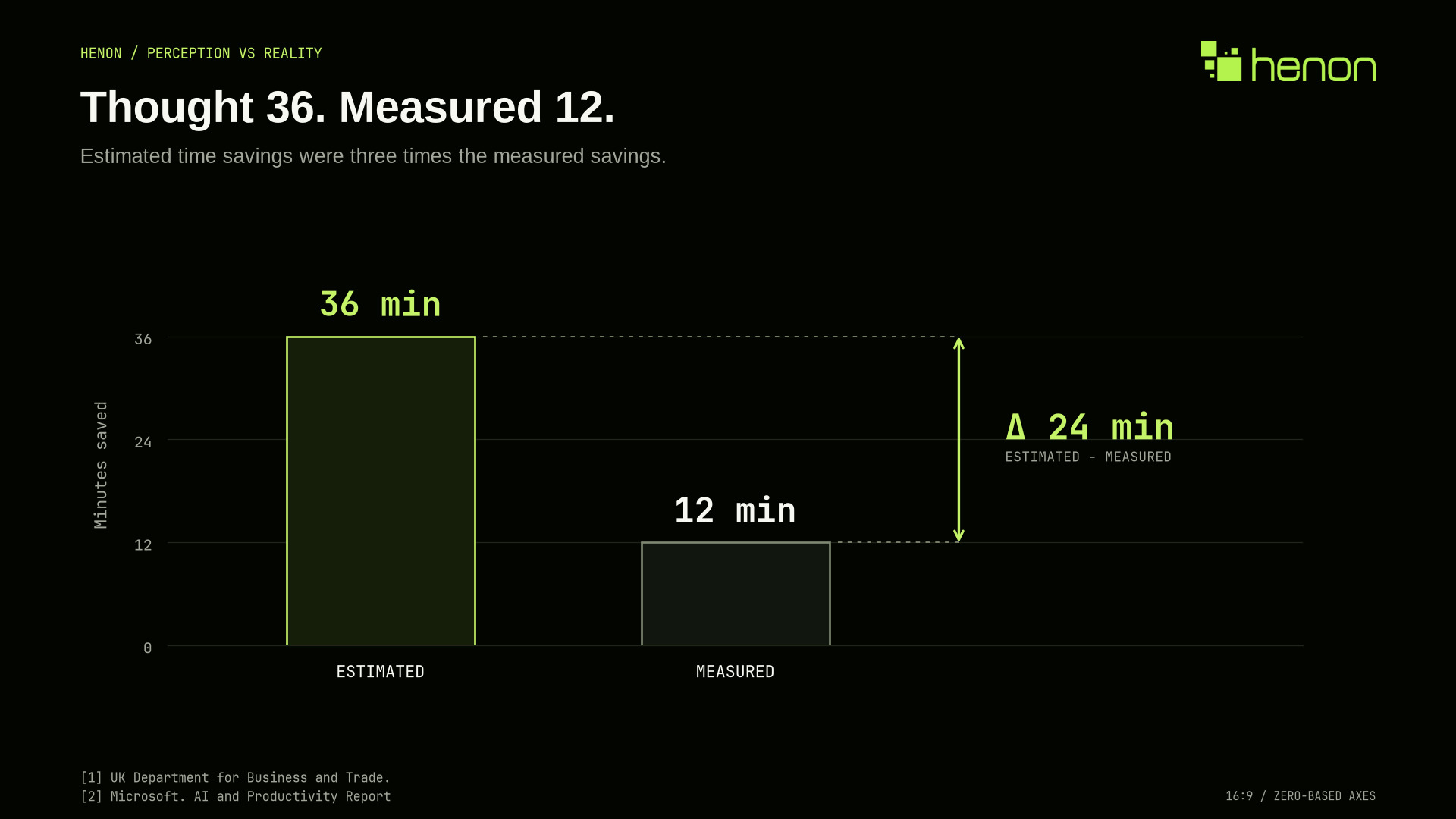
The gap between estimated and measured savings demonstrates why organizations should focus on completed outcomes rather than perceived productivity improvements.
Where GenAI Copilots Deliver Real Value
Despite the perception gap, the evidence still supports meaningful productivity gains in selected workflows.
Multiple studies found that AI-assisted users completed drafting, summarization, and information synthesis tasks significantly faster than manually performing the same work.
The largest gains consistently appear in activities where substantial amounts of content must be processed, synthesized, or created:
- Document summarization
- First-draft content creation
- Research synthesis
- Email drafting
- Knowledge retrieval
- Information consolidation
These workflows benefit because prompting overhead represents only a small fraction of the effort being replaced.
When AI eliminates twenty or thirty minutes of reading, writing, or information gathering, the economics are obvious. When it attempts to replace a task that already takes only a minute or two, the advantage becomes less certain.
Key Statistics
- Measured Time Savings: 12 minutes per task on average in controlled testing.
- Perceived Time Savings: 36 minutes per task reported by participants.
- Report Summarization: Nearly 3x faster with AI assistance.
- Professional Writing: Significant reductions in completion time while maintaining comparable output quality.
- Knowledge Worker Impact: The strongest evidence points to improvements in communication, drafting, and information processing workflows rather than universal productivity gains.
The Verification Problem
The counterargument is not that AI provides no value. The challenge is that generating content is only one component of completing work.
Organizations consume finished outputs, not first drafts.
Research comparing AI-assisted and manual workflows demonstrates that the relationship between speed and quality varies significantly by task type.
In some activities, AI accelerated completion. In others, users spent additional time validating outputs, correcting errors, or rebuilding work to meet required standards.
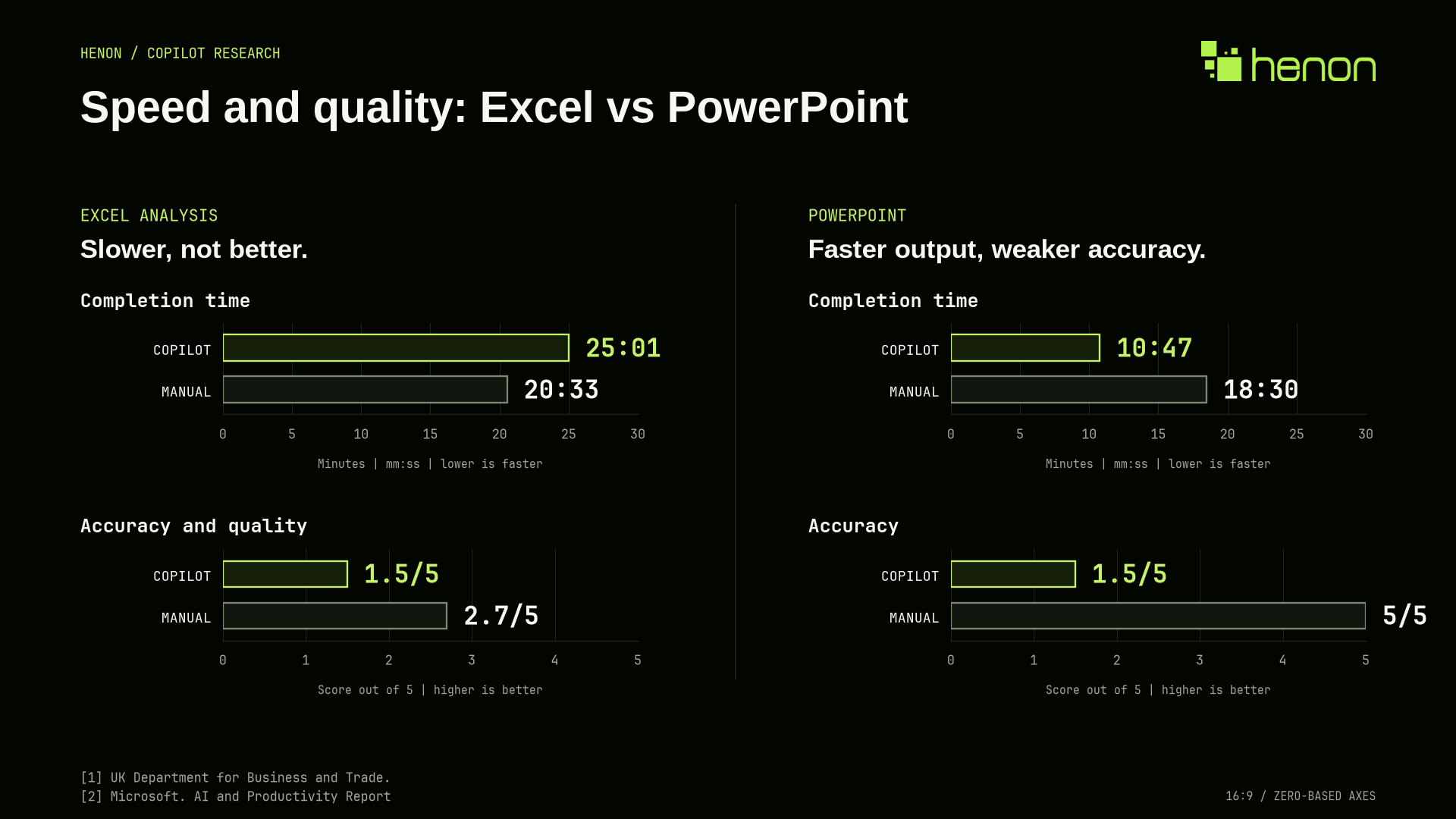
The findings suggest that speed alone should not be treated as a productivity metric.
A presentation generated in half the time may still require extensive revisions before it can be shared with a customer or executive team. Likewise, a spreadsheet produced quickly may lose its value if the calculations require extensive validation.
For regulated, financial, legal, or client-facing work, correctness often matters more than generation speed.
The Reality: Productivity Is Task Dependent
- The evidence does not support either extreme position.
- GenAI copilots are not simply expensive ways to perform basic computer tasks that experienced professionals can already complete efficiently.
- Nor are they universal productivity multipliers capable of transforming every workflow.
- The outcome depends heavily on the balance between work eliminated and review effort introduced.
- For simple actions such as formatting, administration, or routine software navigation, the effort required to prompt, supervise, and validate AI may equal or exceed the manual alternative.
- For larger activities such as drafting reports, synthesizing research, analyzing information, or creating first-pass content, AI can eliminate substantial amounts of manual effort and produce measurable gains.
- The dividing line is often not generation speed, but verification cost.
When the effort required to review and correct output remains low, AI creates value. When review becomes extensive, gains narrow quickly.
In Summary
The strongest available evidence suggests that GenAI copilots can create meaningful productivity gains in drafting, summarization, and information synthesis tasks. However, measured improvements are frequently much smaller than users perceive.
Organizations should evaluate AI using completed, approved deliverables rather than generated outputs. The most successful deployments will focus on workflows where the volume of work avoided materially exceeds the effort required to validate the result.
As enterprise AI matures, the question will become less about whether AI saves time and more about where it saves time reliably enough to matter.
Written by Henon
The opinions expressed are those of Henon Financial Technologies Inc. ("Henon"). The information and/or analysis contained in this material have been compiled or arrived at from sources believed to be reliable but Henon does not make any representation as to their accuracy, correctness, usefulness or completeness and does not accept liability for any loss arising from the use hereof or the information and/or analysis contained herein. Henon disclaims any responsibility to update such information. Neither Henon or its affiliates, nor any of their directors, officers or employees shall assume any liability or responsibility for any direct or indirect loss or damage or any other consequence of any person acting or not acting in reliance on the information contained herein. All overviews and commentary are intended to be general in nature and for current interest. While helpful, these overviews are no substitute for professional tax, investment or legal advice. Clients should seek professional advice for their unique situation. Neither Henon nor any of its affiliates or representatives is providing tax, investment, or legal advice. Past performance does not guarantee future results. This material was prepared solely for informational purposes, does not constitute an offer or an invitation by or on behalf of Henon to any person to buy or sell any security and is no indication of trading intent in any fund or account managed by Henon. No investment strategy or risk management technique can guarantee returns or eliminate risk in any market environment. Unless otherwise specified, all data is sourced from Henon. The Stylized Henon Design, and Henon Logo are trademarks of Henon Financial Technologies Inc.